ATEX Zones Explained: 0, 1, 2, 20, 21 & 22
If your facility handles flammable gases, vapours or combustible dust, understanding ATEX zones is an important part of managing workplace safety.
Different areas within the same facility can have different classifications, depending on the materials being handled and how frequently an explosive atmosphere is expected to develop.
Knowing what these classifications mean helps facilities understand the precautions required and select equipment suitable for the environment.
What Is an ATEX Zone?
An ATEX zone is a designated area where an explosive atmosphere may occur due to the presence of flammable gases, vapours, mists or combustible dust.
ATEX takes its name from the French term atmosphères explosibles and is associated with European legislation covering explosive-atmosphere safety.
Two important directives are:
- Directive 1999/92/EC, which addresses the protection of workers in environments where explosive atmospheres may occur.
- Directive 2014/34/EU, which covers equipment and protective systems intended for use in potentially explosive atmospheres.
In Great Britain, workplace risks involving explosive atmospheres are managed under the Dangerous Substances and Explosive Atmospheres Regulations (DSEAR).
DSEAR requires employers to assess risks from dangerous substances, identify areas where explosive atmospheres may occur and implement appropriate safety measures.
These areas are classified into zones based on how frequently an explosive atmosphere is expected to occur and how long it may remain present.

What Are the Different ATEX Zones?
There are six ATEX zones, divided into two categories:
- Zones 0, 1 and 2: Flammable gases, vapours and mists.
- Zones 20, 21 and 22: Combustible dust.
The classifications describe the likelihood and duration of an explosive atmosphere, rather than simply whether a flammable material is present.
ATEX Zones 0, 1 and 2: Gas and Vapour
Gas zones apply to environments where flammable gases, vapours or mists could mix with air and create an explosive atmosphere.
These conditions may occur in facilities handling fuels, solvents, paints, chemicals and other flammable substances.
ATEX Zone 0
An area where an explosive atmosphere consisting of flammable gas, vapour or mist is present continuously, for long periods or frequently.
ATEX Zone 1
An area where an explosive atmosphere consisting of flammable gas, vapour or mist is likely to occur occasionally during normal operations.
ATEX Zone 2
An area where an explosive atmosphere consisting of flammable gas, vapour or mist is not likely to occur during normal operations. If it does occur, it is expected to persist for only a short period.
ATEX Zones 20, 21 and 22: Combustible Dust
Dust zones apply to environments where combustible dust particles may become suspended in the air and create an explosive atmosphere.
These hazards can occur in industries including food manufacturing, grain processing, woodworking, pharmaceuticals and certain metalworking operations.
ATEX Zone 20
An area where an explosive atmosphere in the form of a cloud of combustible dust is present continuously, for long periods or frequently.
ATEX Zone 21
An area where an explosive atmosphere in the form of a cloud of combustible dust is likely to occur occasionally during normal operations.
ATEX Zone 22
An area where an explosive atmosphere in the form of a cloud of combustible dust is not likely to occur during normal operations. If it does occur, it is expected to persist for only a short period.
It’s important to understand that handling combustible materials doesn’t automatically mean an entire facility is classified as an ATEX zone.
For example, a food manufacturing facility handling flour may have specific areas where combustible dust clouds could develop, while other parts of the building remain unclassified.
The appropriate classification depends on the processes taking place, the potential for explosive atmospheres to develop and the findings of the site’s hazardous-area assessment.
Why Do ATEX Zones Matter for High-Level Cleaning?
Combustible dust can accumulate in areas that are difficult to inspect and clean during routine maintenance.
Overhead pipework, structural beams, cable trays, ventilation systems and production equipment can all collect dust over time.
Although settled dust is different from an airborne explosive dust cloud, accumulated deposits can become hazardous if disturbed and dispersed into the air.
This is why appropriate housekeeping and dust management are important in facilities handling combustible materials.
However, the cleaning process itself also needs consideration. Disturbing dust, introducing unsuitable equipment or failing to control potential ignition sources could increase the risks associated with an already hazardous environment.
To understand how these conditions can contribute to an explosion, read our guide to the 5 elements of a combustible dust explosion.
What ATEX Cleaning Equipment Do I Need?
Selecting suitable cleaning equipment depends on the hazardous-area classification, the characteristics of the material being collected and the intended application.
Equipment used in a classified hazardous area must be suitable for the relevant zone and operating conditions.
ATEX cleaning systems are designed to control potential ignition sources, including hazardous electrostatic discharge and mechanical or electrical sparking.
SpaceVac’s ATEX high-level cleaning systems incorporate conductive carbon fibre poles and specialist accessories designed to help prevent hazardous static build-up during cleaning.
These components must be used with appropriately specified vacuum equipment to provide a cleaning arrangement suitable for the intended application.
It’s important to consider the complete system, including the vacuum, poles, hoses and accessories, rather than assuming that one conductive component makes an entire system suitable for use in a hazardous area.
For facilities outside classified hazardous areas, appropriately specified ACD industrial vacuum equipment may be suitable for certain combustible dust collection applications.
The correct approach depends on the site’s risk assessment and the equipment manufacturer’s specifications.
For further information, read our guide to what ATEX certified equipment is.
SpaceVac ATEX High-Level Cleaning Systems
SpaceVac manufactures specialist high-level cleaning systems designed to help facilities remove accumulated dust from difficult-to-reach surfaces.
Our ATEX range combines conductive carbon fibre pole technology with specialist cleaning accessories to support high-level cleaning in appropriately assessed hazardous environments.
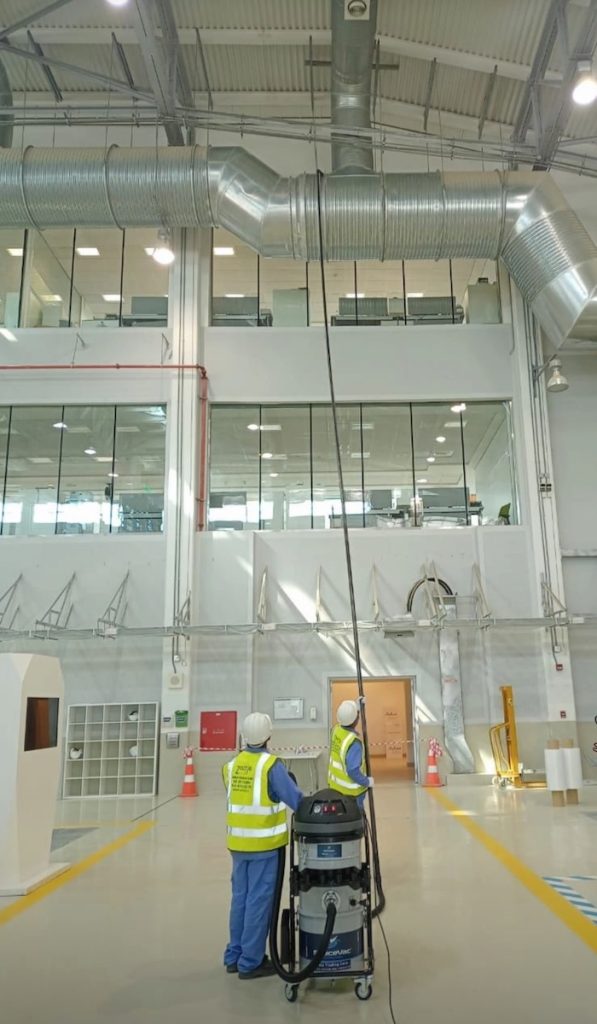
By allowing operators to reach elevated surfaces from ground level, these systems can reduce reliance on scaffolding, mobile access platforms and other working-at-height equipment.
The range includes several options to accommodate different working heights and cleaning requirements.
ATEX Lite
The SpaceVac ATEX Lite provides an entry-level option for facilities requiring a specialist high-level cleaning system.
Its compact configuration makes it a practical starting point for applications with more modest working-height requirements.
ATEX Pioneer
The ATEX Pioneer is designed for facilities requiring additional reach and flexibility when cleaning elevated surfaces.
Its lightweight conductive pole system helps operators access overhead pipework, structural beams and other difficult-to-reach areas.
ATEX Pro 38mm
The ATEX Pro 38mm offers a balance of reach, manoeuvrability and cleaning capability for industrial applications.
Its 38mm conductive carbon fibre pole system is designed to support regular high-level cleaning in facilities with challenging access requirements.
ATEX Pro 50mm
The ATEX Pro 50mm features a larger-diameter pole system for more demanding cleaning applications.
The 50mm configuration can be beneficial where greater airflow capacity and the collection of larger quantities of debris are important considerations.
ATEX Ultra
The ATEX Ultra is designed for facilities with demanding high-level cleaning requirements, including applications involving greater working heights.
Its specialist carbon fibre pole construction combines strength and reduced weight to support extended-reach cleaning.
Choosing the Right ATEX Cleaning System
There is no single cleaning system suitable for every industrial environment.
The correct equipment depends on several factors, including the site’s hazardous-area classification, the type of dust being collected, working height, cleaning frequency and access restrictions.
SpaceVac offers a range of specialist high-level cleaning systems and can help facilities explore options appropriate to their cleaning requirements.
Explore our ATEX High-Level Cleaning Systems or contact our team to discuss your facility’s requirements.
Other related news



Trusted by