What Is High-Level Cleaning? A Complete Industrial Guide
25-06-2026
High-level cleaning involves cleaning areas that are difficult to access during normal day-to-day housekeeping, typically anything above 2 meters from the floor.
In industrial and commercial environments, dust and debris do not stay neatly at ground level. Over time, airborne particles settle onto elevated surfaces such as roof beams, ducting, pipework, lighting, cable trays, ventilation systems and overhead structures.
Because these areas are often out of sight, they are easy to overlook and, in many facilities, that creates a false sense of security.
A production floor can appear clean, organised and well maintained while significant contamination continues to build quietly above the working environment.
Why High-Level Cleaning Matters
One of the biggest misconceptions is that high-level cleaning is a maintenance issue when, in reality, it is often a safety issue.
In some environments, overhead contamination affects hygiene standards, air quality, equipment performance and long-term maintenance costs.
In others, particularly facilities handling combustible dust, the consequences can be far more serious.
Fine dust particles do not need to be visible across the floor to become dangerous. Once disturbed, settled dust can become airborne extremely quickly. If it encounters an ignition source, the result can be devastating.
This is why overhead housekeeping plays such an important role in industrial risk management.
The Hidden Risk Of Overhead Dust Accumulation
One of the clearest examples of this came from the Imperial Sugar refinery explosion in Port Wentworth, Georgia, in 2008.
Fourteen workers lost their lives. Thirty-six more were injured.
According to the US Chemical Safety Board investigation, the initial explosion occurred inside an enclosed steel conveyor system beneath storage silos. However, the most destructive event happened seconds later when the shockwave lifted large quantities of settled sugar dust from overhead beams, ducts, cable trays and elevated surfaces throughout the facility.
That airborne dust ignited almost instantly. The secondary explosion propagated through multiple buildings with catastrophic force.
The incident highlighted a reality many industrial sites still underestimate:
“A facility can appear clean at ground level while dangerous dust accumulation continues to develop above the sightline.“
In many combustible dust incidents, the initial ignition is not what causes the greatest damage.
The real destruction often comes from secondary explosions fuelled by overhead dust that has accumulated gradually over time.
The Problem With Incomplete Cleaning Coverage
One of the least discussed challenges in industrial cleaning is not whether cleaning takes place, but whether critical overhead areas are actually being reached.
Traditional high-level cleaning methods often rely on scaffolding, ladders, powered access equipment and mobile elevated work platforms (MEWPs).
While these methods can be effective, they can also create operational disruption, increase set-up time and make access around machinery and production lines difficult.
As a result, cleaning coverage is not always as thorough as many businesses assume.
In one industrial cleaning assessment undertaken by SpaceVac, traditional lift-access cleaning methods achieved only around 60% overhead cleaning coverage during the cleaning cycle.
That meant a significant proportion of elevated surfaces remained untreated.
In facilities where combustible dust or airborne contamination are present, incomplete cleaning coverage can allow hazardous accumulation to continue unnoticed for long periods.
The issue is not always poor standards or negligence. In many cases, the overhead areas are simply difficult to reach consistently within live operational environments.
Why High-Level Cleaning Is Often Delayed
We regularly see companies putting off high-level cleaning because of time constraints or concerns around halting production.
In busy industrial facilities, arranging access equipment around operational schedules can quickly become expensive and disruptive.
Because of this, overhead cleaning is often delayed until contamination becomes visibly severe, an audit identifies the issue or operational problems begin to develop.
The problem is that overhead contamination develops gradually.
The day-to-day build-up can be easily missed by workers on the ground. Over time, beams, ducting, pipework and ventilation systems that once looked harmless can become heavily contaminated before anyone realises how serious the accumulation has become.
Why use SpaceVac for high-level cleaning?
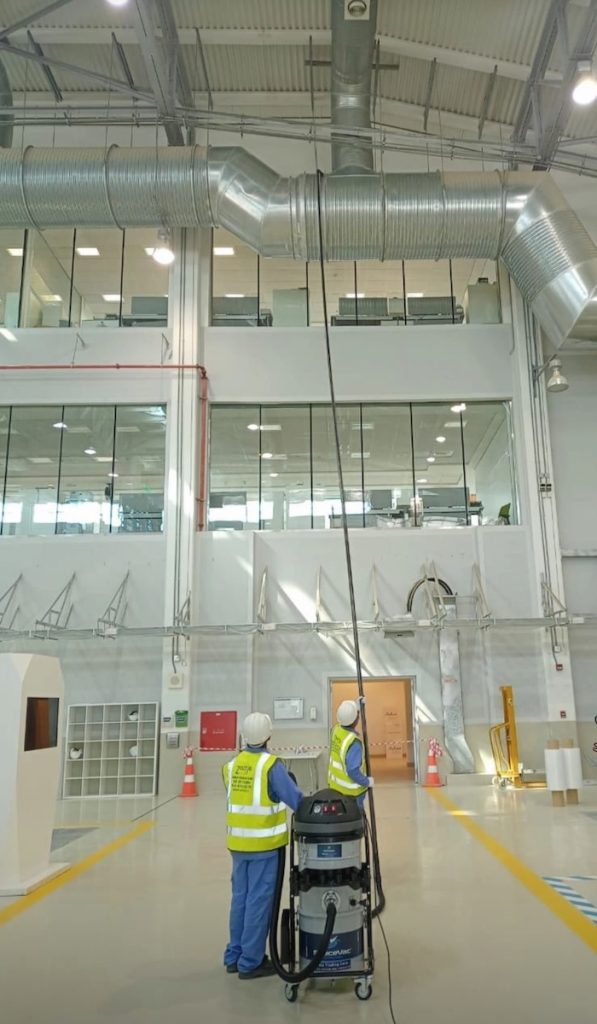
SpaceVac systems enable high-level cleaning and inspection from ground level, reaching heights of up to 16 metres (54ft) without the need for ladders, scaffolding or powered access equipment.
Used for internal cleaning, gutter cleaning and hazardous environment applications, SpaceVac helps businesses improve cleaning coverage while reducing disruption and the costs associated with traditional access methods.
In one recent project at a Lantmännen facility, a cleaning programme that previously achieved only 60% coverage using lift access achieved up to 98% coverage with SpaceVac, while reducing cleaning costs by more than 70%.
For hazardous environments, ATEX-certified SpaceVac systems are available for use in gas zones 0, 1 and 2 and dust zones 20, 21 and 22 when paired with the appropriate certified vacuum.
Trusted by organisations including Nestlé, Weetabix, Lantmännen, Heathrow Airport, the NHS and Nuffield Health, SpaceVac systems are used worldwide to support safer and more effective high-level cleaning.
Want to discuss a high-level cleaning challenge? Contact the SpaceVac team today.
Other related news



Trusted by