The Top 5 Overhead Cleaning Risks in Paper, Tissue and Card Manufacturing
20-01-2026
Overhead dust accumulation is a persistent challenge in paper, tissue and card manufacturing environments. Fine dust generated during production settles on beams, pipework, cable trays and machinery above head height, creating risks that often go unnoticed until they become operational or safety issues.
As production volumes increase and global standards continue to rise, manufacturers are under growing pressure to address these risks in a controlled and sustainable way.
1. Fire and explosion risk from combustible dust
Paper, tissue and card dust is highly combustible, particularly in dry production environments where fine particles accumulate over time. When disturbed by vibration, air movement or maintenance activity, this dust can become airborne and ignite if exposed to heat, sparks or static discharge.
Overhead areas are especially vulnerable because dust is often left undisturbed for long periods, allowing layers to build up beyond safe levels. Without a structured approach to overhead cleaning, these hidden accumulations significantly increase the risk of fire or explosion incidents.
2. Increased production downtime and disruption
Uncontrolled overhead dust build up frequently leads to reactive cleaning and unplanned shutdowns. In many facilities, production must be stopped so that elevated areas can be accessed using powered access equipment or scaffolding.
In large paper manufacturing operations, this disruption can become a daily occurrence. Excessive dust accumulation has forced some facilities to carry out frequent reactive cleans simply to keep production running, creating ongoing inefficiency and avoidable downtime.
3. Contamination of equipment and infrastructure
Dust settling on overhead machinery, lighting, sensors and ventilation systems can reduce performance and reliability. Accumulated dust can interfere with cooling systems, contaminate sensitive components and accelerate wear on equipment.
In paper, tissue and card manufacturing, where continuous operation is critical, contamination of overhead infrastructure often leads to increased maintenance requirements and reduced asset lifespan.
4. Health and safety risks for employees
Overhead dust presents a direct risk to employee health, particularly when disturbed during maintenance or cleaning activities. Airborne paper dust can contribute to respiratory issues and long term exposure concerns, especially in enclosed or poorly ventilated areas.
Traditional methods of accessing overhead areas also introduce additional risk. Working at height, moving access equipment through live production environments and operating lifts or scaffolding all increase the likelihood of accidents and near misses.
5. Compliance and audit challenges
As regulatory expectations evolve, manufacturers are increasingly required to demonstrate effective control of combustible dust and safe working practices. Overhead areas are often highlighted during audits when visible dust accumulation is present.
For multi site manufacturing groups operating across different regions, inconsistent approaches to overhead cleaning can create compliance gaps and increase exposure during inspections and audits.
A growing challenge across large scale paper manufacturing
In large tissue and paper manufacturing groups operating across multiple regions, overhead dust accumulation is not a theoretical concern. Excessive dust build up has led to repeated production stoppages, increased cleaning frequency and growing pressure from safety and compliance teams.
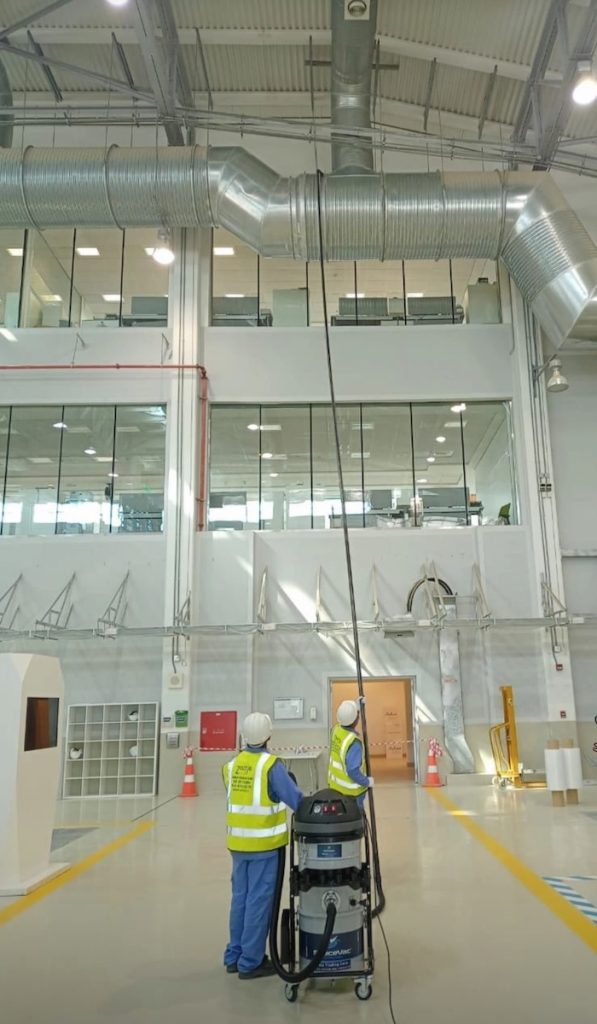
In one large paper manufacturing group operating more than 40 sites, uncontrolled overhead dust resulted in daily reactive cleaning and repeated interruptions to production. Following on site demonstrations of high level cleaning carried out safely from ground level, the company began rolling out permanent overhead cleaning systems across multiple facilities, with further expansion planned as standards and expectations continue to rise.
A more sustainable approach to overhead cleaning
Paper, tissue and card manufacturing environments are particularly susceptible due to fine, dry dust, with similar challenges also present across adjacent sectors including packaging and converting.
Although dust characteristics can vary slightly between paper, tissue and card manufacturing processes, the underlying risks and control requirements remain the same.
As manufacturers expand globally and safety standards rise, proactive management of overhead dust is becoming a baseline requirement rather than a best practice.
By addressing overhead contamination before it becomes a safety or operational issue, manufactures can reduce downtime, improve compliance and create safer working environments without relying on reactive cleaning or high-risk access methods.
See high-level cleaning in action
To see high-level and long-reach cleaning systems in use across industrial environments, view our demonstration videos here.

Other related news



Trusted by